
An Old Error in New Clothes
This is not so much a question for Baptists, who are very clear on this, but for many other groups and individuals there is great and unnecessary confusion on this topic.
There is an old error wearing new clothes. In the first century it was called Judaism creeping into the churches. Paul called its messengers “false brethren unawares brought in” (Galatians 2:4), and he did not stop there:
“And that because of false brethren unawares brought in, who came in privily to spy out our liberty which we have in Christ Jesus, that they might bring us into bondage.”
— Galatians 2:4 (KJV)
Notice what these men were after. They wanted to spy out liberty and bring believers into bondage. Their goal was not to make anyone more holy. Their goal was to make free men slaves again.
Today the same error goes by other names: the Hebrew Roots movement, Torah-observant Christianity, Messianic congregations, Sacred Name groups. It spreads through social media by people who don’t go to good churches (and typically don’t go to any church at all). Men who cannot read a sentence of Hebrew put on prayer shawls, blow shofars, keep feast calendars, avoid pork, and tell simple believers that they cannot truly please God unless they go back to Moses.
This is not a quarrel over preferences. It strikes at the gospel itself. Under the inspiration of the Holy Ghost, Paul wrote:
“Christ is become of no effect unto you, whosoever of you are justified by the law; ye are fallen from grace.”
— Galatians 5:4 (KJV)
If the Holy Spirit called this error deadly in the first century, it is deadly today. And the cure is the same now as it was then: open the Bible and believe it!
This Is a Baptist Battle
Bible-believing Baptists have a particular reason to care about this question. Our people have fought and bled over it for centuries.
Down through the ages, the true churches of the Lord Jesus Christ were hunted, drowned, burned, and banished, often by religious systems that had blended Sinai with the gospel. When churches and governments joined hands, they reached back to the Old Testament for their model. Israel had been a nation with a priesthood, a temple, a tithe enforced by law, and a sword to punish rebels against God. So the state churches built a “Christian Israel”: a sacral nation where every citizen was born into the church, every infant was “circumcised” by baptism, the tithe was collected by force, and dissenters were punished by the magistrate.
Our spiritual forebears refused that model. Men called Donatists, Paulicians, Petrobrusians, Waldenses, and Anabaptists, by whatever name their enemies gave them, held to what the Bible says that a church is a voluntary assembly of saved and baptized believers, not a nation by birth. Peter of Bruys was burned around 1131 for rejecting infant baptism and the religious machinery of his day. In 1527 the Zurich authorities drowned Felix Manz, a man who had come to his convictions by reading the Bible, for baptizing believers. In 1651 Obadiah Holmes was publicly whipped in Puritan Boston for holding a Baptist meeting.
The pattern is the same everywhere. Whenever men treat the churches as a continuation of national Israel, they eventually pick up Israel’s sword. But Christ said, “My kingdom is not of this world” (John 18:36). His churches are not Israel. His people are not under Moses. Three historic Baptist convictions stand at the center of this whole debate:
The sufficiency of Scripture. We do not need rabbinic tradition, a feast calendar, or a “Hebraic mindset” to understand God’s will for us. “All scripture is given by inspiration of God… That the man of God may be perfect, throughly furnished unto all good works” (2 Timothy 3:16-17). The New Testament tells local churches exactly how to worship, live, and order their assemblies.
Individual soul liberty. Each believer answers directly to God through Christ. “One man esteemeth one day above another: another esteemeth every day alike. Let every man be fully persuaded in his own mind” (Romans 14:5). No man has authority to bind a believer’s conscience to a day or a diet that God has not bound on him.
The purity of the local, visible assembly. Every New Testament church is a local congregation of saved and baptized believers, and each one is charged with guarding the doctrine delivered to it. Legalism does not merely confuse individuals. It corrupts congregations.
That is why the clear biblical answer on this topic is so important to Baptists.
To Whom Was the Law Given?
Before we study a single commandment, we must answer a question that almost nobody in the Hebrew Roots movement asks: to whom was the Law of Moses given?
“He sheweth his word unto Jacob, his statutes and his judgments unto Israel. He hath not dealt so with any nation: and as for his judgments, they have not known them. Praise ye the LORD.”
— Psalm 147:19-20 (KJV)
“And what nation is there so great, that hath statutes and judgments so righteous as all this law, which I set before you this day?”
— Deuteronomy 4:8 (KJV)
The Law was a national covenant between God and the nation of Israel, ratified at Sinai with blood (Exodus 24:7-8). Even the preface to the Ten Commandments names the people being addressed: “I am the LORD thy God, which have brought thee out of the land of Egypt, out of the house of bondage” (Exodus 20:2). No Gentile in Corinth or Ephesus had been brought out of Egypt.
Before they were saved, Gentile believers were:
“…aliens from the commonwealth of Israel, and strangers from the covenants of promise, having no hope, and without God in the world.”
— Ephesians 2:12 (KJV)
** You cannot be put back under a covenant you were never under in the first place. **
The Sabbath, the favorite cause of the legalist, was specifically a sign of that national covenant:
“Wherefore the children of Israel shall keep the sabbath, to observe the sabbath throughout their generations, for a perpetual covenant. It is a sign between me and the children of Israel for ever.”
— Exodus 31:16-17 (KJV)
A sign between God and Israel, fulfilled in Christ who is our rest (Hebrews 4). Not one New Testament epistle commands a local church to keep the seventh-day Sabbath. Not once.
Why the Law Was Given
If the Law was never given to save anyone, why did God give it? Paul asks that very question and answers it:
“Wherefore then serveth the law? It was added because of transgressions, till the seed should come to whom the promise was made.”
— Galatians 3:19 (KJV)
Notice the word till. The Law had an end date written into its purpose. It was added until the Seed came, and the Seed is Christ (Galatians 3:16). Once He came, the “till” was reached.
The Law was a diagnosis, not a cure:
“Now we know that what things soever the law saith, it saith to them who are under the law: that every mouth may be stopped, and all the world may become guilty before God. Therefore by the deeds of the law there shall no flesh be justified in his sight: for by the law is the knowledge of sin.”
— Romans 3:19-20 (KJV)
A thermometer can tell you that you have a fever, but it cannot bring the fever down. A mirror can show you the dirt on your face, but nobody washes his face with a mirror. The Law shuts every mouth, finds the whole world guilty, and shows a man what he is. It has no power to make him anything else.
Paul illustrates this with the schoolmaster:
“Wherefore the law was our schoolmaster to bring us unto Christ, that we might be justified by faith. But after that faith is come, we are no longer under a schoolmaster.”
— Galatians 3:24-25 (KJV)
In the Roman world, the schoolmaster was a household guardian placed over a child until the child came of age. He was strict, and he was temporary by design. When the boy became a man, the guardian’s authority ended. No grown son keeps his childhood tutor following him around the house.
Yet that is exactly what the Hebrew Roots movement demands. It asks full-grown, Spirit-indwelt sons of God to crawl back under the guardian whose job ended when faith came. Paul says the opposite: “Wherefore thou art no more a servant, but a son” (Galatians 4:7).
Fulfilled Means Finished
Here we meet the legalist’s favorite proof text:
“Think not that I am come to destroy the law, or the prophets: I am not come to destroy, but to fulfil. For verily I say unto you, Till heaven and earth pass, one jot or one tittle shall in no wise pass from the law, till all be fulfilled.”
— Matthew 5:17-18 (KJV)
The legalist reads this and says, “Jesus said the Law will never pass away!” But read it again. Jesus did not say the Law would never pass. He said it would not pass till all be fulfilled. Those are very different statements.
Think of a mortgage on a house and suppose a wealthy friend walks into the bank and pays off every remaining cent. He has not destroyed your loan agreement. He has not broken the bank’s rules or cheated the system. He has fulfilled the contract down to the last penny. And because it is fulfilled, the contract is finished. The bank no longer has any claim on you. You are free, not because the agreement was ignored, but because it was paid in full.
That is what the Lord Jesus did with the Law. He was “made of a woman, made under the law, To redeem them that were under the law” (Galatians 4:4-5). He was born under Sinai’s jurisdiction and kept every jot and tittle. He fulfilled its demands by His life and its penalty by His death. Every sacrifice pointed to Him, and He became the sacrifice. Every Passover pointed to Him: “For even Christ our passover is sacrificed for us” (1 Corinthians 5:7). Every Sabbath pointed to rest, and He is the rest (Matthew 11:28; Hebrews 4:9-10).
Then, on the cross, He cried, “It is finished” (John 19:30). The debt was paid.
The Holy Ghost tells us the result:
“For Christ is the end of the law for righteousness to every one that believeth.”
— Romans 10:4 (KJV)
The word end means the finish, the goal, the completion. Christ is not the doorway back into the Law. He is where the Law ends.
Abolished, Blotted Out, Disannulled
If anyone still doubts, the Holy Spirit has used language so plain that a man has to work hard to misunderstand it.
Abolished:
“Having abolished in his flesh the enmity, even the law of commandments contained in ordinances; for to make in himself of twain one new man, so making peace.”
— Ephesians 2:15 (KJV)
Not paused. Not handed over to the Gentiles. Abolished. The “middle wall of partition” (Ephesians 2:14) that separated Jew from Gentile was the Law itself, and Christ broke it down.
Blotted out and nailed to the cross:
“Blotting out the handwriting of ordinances that was against us, which was contrary to us, and took it out of the way, nailing it to his cross.”
— Colossians 2:14 (KJV)
And notice Paul’s very next sentence:
“Let no man therefore judge you in meat, or in drink, or in respect of an holyday, or of the new moon, or of the sabbath days: Which are a shadow of things to come; but the body is of Christ.”
— Colossians 2:16-17 (KJV)
This is remarkable. Paul takes the exact list the Hebrew Roots movement cares most about (food laws, feast days, new moons, and Sabbaths) and says, let no man judge you about them. They were shadows. When the body arrives, you do not stand around admiring the shadow. The body is Christ.
Disannulled and vanishing:
“For there is verily a disannulling of the commandment going before for the weakness and unprofitableness thereof. For the law made nothing perfect, but the bringing in of a better hope did; by the which we draw nigh unto God.”
— Hebrews 7:18-19 (KJV)
“In that he saith, A new covenant, he hath made the first old. Now that which decayeth and waxeth old is ready to vanish away.”
— Hebrews 8:13 (KJV)
“He taketh away the first, that he may establish the second.”
— Hebrews 10:9 (KJV)
Abolished. Blotted out. Nailed. Disannulled. Made old. Taken away. How many ways must the Holy Spirit say it before men will believe Him?
The Tables of Stone: The Loophole Closed
At this point many legalists retreat. “Fine,” they say, “the sacrifices and ceremonies are gone. But the Ten Commandments are the moral law, and they remain.”
Paul shuts that door in 2 Corinthians 3. There he contrasts the old covenant and the new, and he tells us exactly what part of the old covenant he means:
“But if the ministration of death, written and engraven in stones, was glorious, so that the children of Israel could not stedfastly behold the face of Moses for the glory of his countenance; which glory was to be done away: How shall not the ministration of the spirit be rather glorious?”
— 2 Corinthians 3:7-8 (KJV)
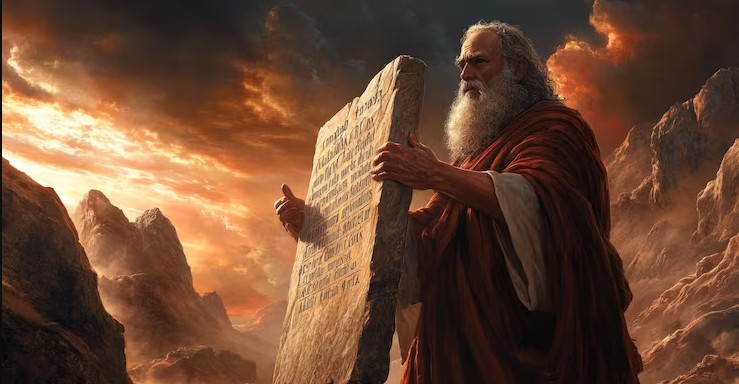
What was written and engraven in stones? Not the sacrificial code. Not the laws of mildew and leprosy. The Ten Commandments. God wrote them on the tables of stone with His own finger (Exodus 31:18; 34:28). And the Holy Spirit calls that ministration “the ministration of death” and “the ministration of condemnation” (v. 9).
Then Paul tells us what happened to it:
“For if that which is done away was glorious, much more that which remaineth is glorious.”
— 2 Corinthians 3:11 (KJV)
“And not as Moses, which put a vail over his face, that the children of Israel could not stedfastly look to the end of that which is abolished.”
— 2 Corinthians 3:13 (KJV)
Done away. Abolished. Spoken of the covenant written on stone.
Paul contrasts it with what God does now: the believer is written upon “not in tables of stone, but in fleshy tables of the heart” (2 Corinthians 3:3). The old covenant was “the letter” that “killeth”; the new is the Spirit that “giveth life” (v. 6). The letter demanded obedience but gave no power to obey. The Spirit gives life.
This does not mean God’s holiness changed. It means the covenant administration engraved on stone, as a system of rule over the believer, has ended.
The Rent Veil
Hebrews 9 teaches the same truth through the tabernacle itself.
“Then verily the first covenant had also ordinances of divine service, and a worldly sanctuary.”
— Hebrews 9:1 (KJV)
A first covenant implies a second. It had a worldly sanctuary, meaning an earthly one, in contrast to the heavenly. Into the holiest of all “went the high priest alone once every year, not without blood, which he offered for himself, and for the errors of the people” (Hebrews 9:7). The common Israelite could never come near God’s presence (Leviticus 16).
“The Holy Ghost this signifying, that the way into the holiest of all was not yet made manifest, while as the first tabernacle was yet standing: Which was a figure for the time then present, in which were offered both gifts and sacrifices, that could not make him that did the service perfect, as pertaining to the conscience; Which stood only in meats and drinks, and divers washings, and carnal ordinances, imposed on them until the time of reformation.”
— Hebrews 9:8-10 (KJV)
The entire system was “a figure for the time then present.” Its meats, drinks, washings, and carnal ordinances were imposed until. These things were not to continue any longer than the time of the Gospel, which is called ‘the time of reformation’, in which saints are directed to Christ, the sum and substance of all types, shadows, and sacrifices, and in whom alone perfection is.
Then the substance came:
“But Christ being come an high priest of good things to come, by a greater and more perfect tabernacle, not made with hands, that is to say, not of this building; Neither by the blood of goats and calves, but by his own blood he entered in once into the holy place, having obtained eternal redemption for us.”
— Hebrews 9:11-12 (KJV)
When Jesus died, “the veil of the temple was rent in twain from the top to the bottom” (Matthew 27:51). From the top. God tore it, not man. The Hebrew Roots movement is busy sewing the veil back together. What God has torn, no man should try to mend.
“For the law was given by Moses, but grace and truth came by Jesus Christ” (John 1:17).
Married to Another: The Charge of Spiritual Adultery
Paul uses the law of marriage to show why no believer can belong to Moses and Christ at the same time:
“Know ye not, brethren, (for I speak to them that know the law,) how that the law hath dominion over a man as long as he liveth? For the woman which hath an husband is bound by the law to her husband so long as he liveth; but if the husband be dead, she is loosed from the law of her husband. So then if, while her husband liveth, she be married to another man, she shall be called an adulteress: but if her husband be dead, she is free from that law; so that she is no adulteress, though she be married to another man. Wherefore, my brethren, ye also are become dead to the law by the body of Christ; that ye should be married to another, even to him who is raised from the dead, that we should bring forth fruit unto God.”
— Romans 7:1-4 (KJV)
The principle is simple. A marriage binds until death. Only death dissolves it. And a woman who takes a second husband while still bound to the first is an adulteress.
Paul’s application is just as simple. Death has broken the believer’s bond to the Law. We are “become dead to the law by the body of Christ.” When Christ died, we died with Him (Galatians 2:19-20), and the old marriage was ended. Now we are lawfully married to another: the risen Christ.
So what is a believer doing when he tries to cling to Moses while claiming Christ? He is trying to keep two husbands. That is spiritual adultery. The bride of Christ does not keep her former husband’s rules on the side. “But now we are delivered from the law, that being dead wherein we were held; that we should serve in newness of spirit, and not in the oldness of the letter” (Romans 7:6).
The Yoke Nobody Could Bear
The apostles settled this very controversy at Jerusalem. Certain men had come down to Antioch teaching, “Except ye be circumcised after the manner of Moses, ye cannot be saved” (Acts 15:1). Others insisted “that it was needful to circumcise them, and to command them to keep the law of Moses” (Acts 15:5).
That is the Hebrew Roots message in its original form: you are not truly right with God unless you keep Moses.
Peter, a Jew who had lived under the Law his whole life, answered:
“Now therefore why tempt ye God, to put a yoke upon the neck of the disciples, which neither our fathers nor we were able to bear? But we believe that through the grace of the Lord Jesus Christ we shall be saved, even as they.”
— Acts 15:10-11 (KJV)
A yoke that neither Peter nor his fathers could bear. And Jews would be saved exactly as the Gentiles were: by grace through faith, not by Moses.
Hagar or Sarah: Choose One
Paul closes his argument in Galatians 4 with an allegory from Abraham’s household:
“Which things are an allegory: for these are the two covenants; the one from the mount Sinai, which gendereth to bondage, which is Agar.”
— Galatians 4:24 (KJV)
Sinai is Hagar, the bondwoman. Sinai produces slaves. “But Jerusalem which is above is free, which is the mother of us all” (Galatians 4:26).
Every true New Testament church is a Sarah congregation. It is born of promise, not of the flesh. It is governed by grace, not by Sinai’s whip. It rests in a finished work. The Judaizer is not merely trying to change an individual’s calendar. He is trying to bring Hagar back into the house of the free.
And what does God say to do with her?
“Nevertheless what saith the scripture? Cast out the bondwoman and her son: for the son of the bondwoman shall not be heir with the son of the freewoman. So then, brethren, we are not children of the bondwoman, but of the free.”
— Galatians 4:30-31 (KJV)
God did not say to reform Hagar, decorate her, or make a compromise with her. He said, Cast out the bondwoman.
Conclusion of Part One
So far the Scriptures have shown us that the Law was a covenant with national Israel, never with Gentiles or local churches. It was added till the Seed came. It was a schoolmaster to bring us to Christ, and now that faith has come, we are no longer under it. Christ fulfilled the Law in full and became its end. The handwriting of ordinances was nailed to His cross. The tables of stone themselves are called the ministration of death, and their glory was done away. The veil is rent. We are dead to the Law and married to another.
But that raises a serious question. If the believer is not under the Law, is he lawless? What governs his life? What keeps him from sin? And what about the verses the legalists keep quoting?
Those questions have plain biblical answers, and Part Two will give them. For now:
“Stand fast therefore in the liberty wherewith Christ hath made us free, and be not entangled again with the yoke of bondage.”
— Galatians 5:1 (KJV)
Continued in Part 2 (coming soon!)