
What Repentance Means — And What It Does Not
Few words have been more twisted than the word repentance.
In many churches today, people are told that to be saved they must “turn from their sins,” “stop sinning,” “forsake their sins,” or “change their life.” That may sound spiritual, but it is not the gospel. It adds human effort to the finished work of Jesus Christ and leaves sinners looking at themselves instead of looking to the Saviour.
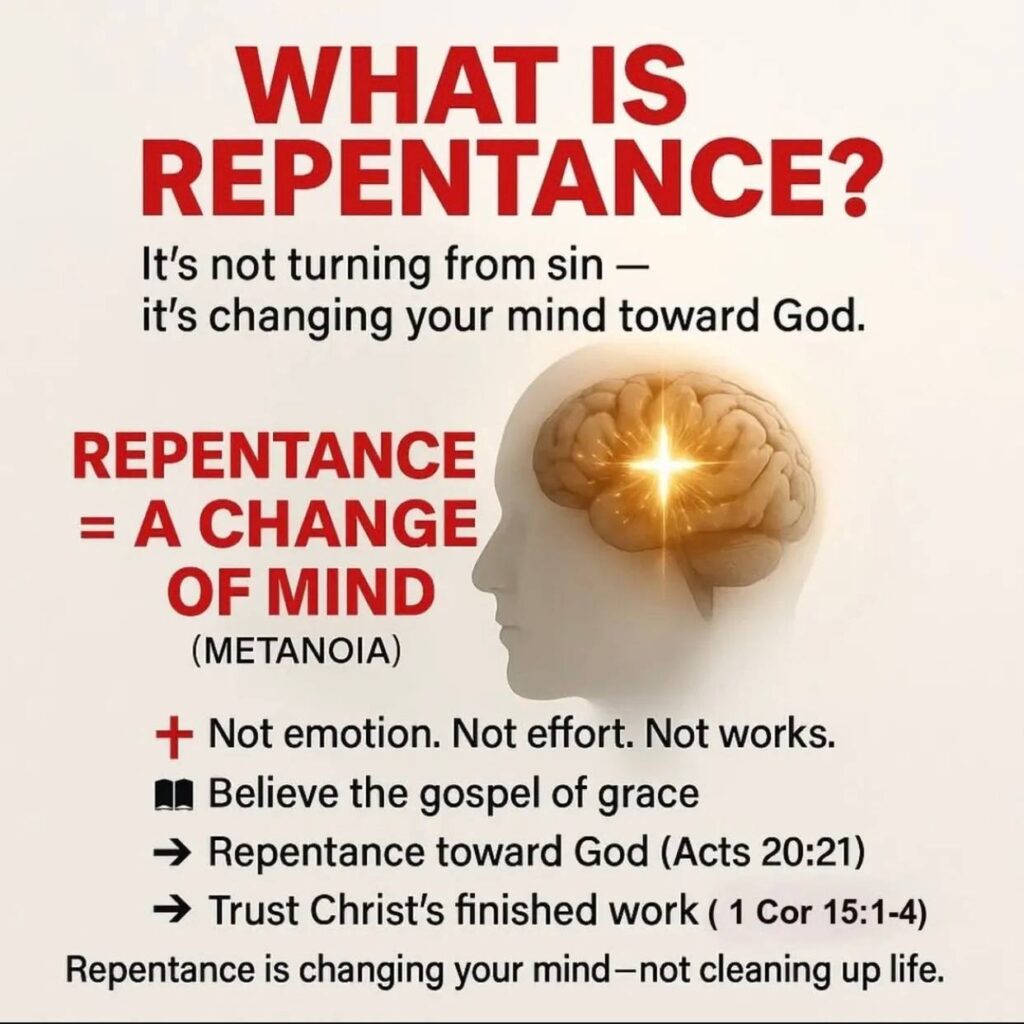
In the context of eternal salvation, repentance means a change of mind. It is changing your mind from whatever you were trusting before — religion, works, idols, self-righteousness, a false gospel, or unbelief — to trusting Jesus Christ alone.
Repentance is not cleaning up your life. It is not promising God you will stop sinning. It is not surrendering every area of your life in order to be saved. It is not “making a deal with God” that you will behave better from now on.
Salvation is not faith plus reformation. It is not faith plus sorrow. It is not faith plus obedience. It is not faith plus turning from sins.
Salvation is by grace through faith in Christ alone.
The Simple Biblical Definition
The words translated repent and repentance carry the idea of a change of mind. More importantly, the Bible itself shows us how the word is used. Repentance does not mean “turn from sins.” The context must determine the meaning.
When Jesus began preaching, He said:
“The time is fulfilled, and the kingdom of God is at hand: repent ye, and believe the gospel.”
— Mark 1:15 (KJV)
Notice that repentance is connected directly with believing the gospel. Jesus did not say, “Repent ye, and turn from all your sins.” He said, “repent ye, and believe the gospel.”
Paul described John the Baptist’s message the same way:
“Then said Paul, John verily baptized with the baptism of repentance, saying unto the people, that they should believe on him which should come after him, that is, on Christ Jesus.”
— Acts 19:4 (KJV)
John preached repentance, and Paul explains that message as telling the people to believe on Christ Jesus.
That is the issue in salvation: belief. A man must change his mind from unbelief to belief, from false trust to true trust, from trusting in their dead works to faith toward God.
Repentance From Dead Works
Hebrews gives one of the clearest statements in the Bible:
“Therefore leaving the principles of the doctrine of Christ, let us go on unto perfection; not laying again the foundation of repentance from dead works, and of faith toward God.”
— Hebrews 6:1 (KJV)
Repentance is “from dead works” and is connected with “faith toward God.”
Dead works are anything a man trusts in to earn, keep, prove, or help pay for salvation. That includes religious rituals, baptism, church membership, law-keeping, good deeds, personal reform, attempts to stop sinning, turning from sins, or any confidence in self-righteousness.
If a person is trusting his works, he needs to repent — not by doing more works, but by changing his mind and trusting Christ alone.
Your works cannot save you. Your sorrow cannot save you. Your promise to do better cannot save you. Your attempt to clean up your life cannot save you.
Christ alone saves.
What Repentance Is a Change of Mind About
The Bible shows what a person may need to change his mind about.
From Unbelief to Belief
Jesus rebuked the religious leaders because they refused to believe John’s message:
“For John came unto you in the way of righteousness, and ye believed him not: but the publicans and the harlots believed him: and ye, when ye had seen it, repented not afterward, that ye might believe him.”
— Matthew 21:32 (KJV)
The issue was not that they failed to stop sinning enough. The issue was that they believed him not.
The publicans and harlots believed. The religious leaders did not. Jesus said they did not repent, meaning they did not change their minds so that they might believe.
Repentance here is directly connected to belief.
From Idols to the Living God
Paul said of the Thessalonians:
“For they themselves shew of us what manner of entering in we had unto you, and how ye turned to God from idols to serve the living and true God.”
— 1 Thessalonians 1:9 (KJV)
They turned to God from idols. Their faith was no longer in false gods. They had turned to the living and true God.
They were not saved because they served enough. They served because they had believed on the true God.
From Self-Righteousness to Christ’s Righteousness
Paul said of Israel:
“For they being ignorant of God’s righteousness, and going about to establish their own righteousness, have not submitted themselves unto the righteousness of God.”
— Romans 10:3 (KJV)
Then he says:
“For Christ is the end of the law for righteousness to every one that believeth.”
— Romans 10:4 (KJV)
This is exactly where many religious people are today. They are trying to establish their own righteousness. They think salvation depends on how much they have changed, how sorry they are, how many sins they have turned from, or how faithful they promise to be.
But Christ is the end of the law for righteousness to every one that believeth.
A man is not saved by turning from sins. He is saved by believing on Christ. Turning from sins is work. Believing is receiving what Christ has already done.
The Bible even says of Nineveh:
“And God saw their works, that they turned from their evil way…”
— Jonah 3:10 (KJV)
Turning from evil ways is called works. Works have an important place in the Christian life, but they have no place as a condition for receiving everlasting life.
From a False Jesus to the Biblical Jesus
There are many counterfeit Jesuses preached today. Paul warned:
“For if he that cometh preacheth another Jesus, whom we have not preached…”
— 2 Corinthians 11:4 (KJV)
A person must believe on the biblical Lord Jesus Christ: God manifest in the flesh, the Son of God, who died for our sins, was buried, and rose again the third day.
Repentance means changing your mind from every false christ and every false gospel to the true Christ and the true gospel.
Jesus said:
“I am the way, the truth, and the life: no man cometh unto the Father, but by me.”
— John 14:6 (KJV)
There is no salvation in idols, religion, sacraments, self-righteousness, law-keeping, or works. Salvation is in Christ alone.
The Result: Assurance of Eternal Life
When a sinner believes on Jesus Christ alone, he receives everlasting life. This is not a “hope-so” salvation. It is a “know-so” salvation.
“These things have I written unto you that believe on the name of the Son of God; that ye may know that ye have eternal life…”
— 1 John 5:13 (KJV)
Jesus said:
“Verily, verily, I say unto you, He that believeth on me hath everlasting life.”
— John 6:47 (KJV)
And again:
“He that believeth on the Son hath everlasting life…”
— John 3:36 (KJV)
The condition is belief. Not turning from sins. Not joining a church. Not being baptized. Not persevering in works. Not proving yourself.
He that believeth hath everlasting life.
Don’t mix up salvation with what SHOULD be done AFTER salvation!
Are you trusting Christ alone? Read more about the Bible way to Heaven.