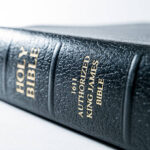


We love the King James Bible. We believe without apology or hesitation that the KJV is the preserved Word of God for the English-speaking people. It is our absolute, infallible, and inerrant standard of truth.
But there is a massive difference between standing on the preserved Word of God and running off into the theological circus known as Ruckmanism.
Few movements have done more to make Bible-believing Baptists look like irrational, unscholarly cultists than the followers of the late Peter S. Ruckman. While pretending to be the ultimate defenders of the Book, Ruckmanites have invented a bizarre, unscriptural doctrine that actually overthrows the very Bible they claim to protect.
Their heresy that this post focuses on is the laughable claim of “advanced revelation” (or “double inspiration”). This is the claim that the King James translators were supernaturally inspired to write brand-new revelation into the text, and that the English translation actually corrects, improves upon, and stands superior to the divinely preserved Hebrew and Greek manuscripts from which it was translated.
To put it plainly: this idea is absurd. It is logically brainless, spiritually dangerous, and thoroughly unscriptural.
The Logical Collapse of “Translation Idolatry”
The entire premise of Ruckmanism collapses under the weight of basic biblical logic. A translation cannot be an improvement upon what it is translating.
The legitimacy of the King James Bible does not rest on some imaginary “second Pentecost” occurring in England in 1611. It rests on two rock-solid pillars:
- The providential, continuous preservation of the pure original-language texts (the Hebrew Masoretic Text and the Greek Textus Receptus).
- The unmatched skill, fidelity, and aggregate linguistic ability of the King James translation committee, who faithfully translated those pure texts into English.
The moment you claim that a translation improves upon the original texts, you are guilty of translation idolatry. You have cut the translation loose from the very source texts that gave it authority.
Even worse, this foolishness completely plays into the hands of the modernists. If God gives “advanced revelation” through a translation, what is to stop someone from claiming that the NIV, the ESV, or any other modern counterfeit is simply the “latest and greatest” advanced revelation from God?
By Ruckman’s logic, if you find a translation error or a blatant alteration in a modern Bible, you can’t call it corrupt; you just have to assume it’s “fresh light” from heaven! The only standard of proof becomes the loud, arrogant proclamation of the man making the claim. That is exactly how cults operate, not Bible-believing churches.
To claim that God’s Word can be “improved upon” is blasphemy. Solomon put a death-blow to this idea thousands of years ago:
“Every word of God is pure: he is a shield unto them that put their trust in him. Add thou not unto his words, lest he reprove thee, and thou be found a liar.”
— Proverbs 30:5-6 (KJV)
To claim “advanced revelation” in 1611 is to claim that God added to His words. And God says anyone who does that is a liar.
Jesus Rebukes the “1611 Myth”
Ruckmanites act as though the Word of God didn’t actually exist until it “fell from heaven in 1611,” leaving believers in previous centuries with an incomplete, second-rate Bible.
Our Lord Jesus Christ demolished this foolishness in a single sentence:
“But he answered and said, It is written, Man shall not live by bread alone, but by every word that proceedeth out of the mouth of God.”
— Matthew 4:4 (KJV)
When Jesus stood in the wilderness and quoted Deuteronomy to Satan, was He telling mankind to live by words that would not exist for another 1,600 years? Absolutely not.
If believers between the apostolic era and 1611 did not have access to “every word that proceedeth out of the mouth of God,” then Christ’s command was impossible to obey, and His promise of preservation failed. Christ’s statement requires that God’s pure words were already given, already in existence, and already accessible to His people.
God did not wait until 1611 to give His pure Word to the world. It proceeded out of His mouth at the moment of original inspiration, and His sovereign providence has kept those words alive and pure ever since.
As the Preacher declared:
“I know that, whatsoever God doeth, it shall be for ever: nothing can be put to it, nor any thing taken from it: and God doeth it, that men should fear before him.”
— Ecclesiastes 3:14 (KJV)
God’s work of inspiration was complete and perfect the first time. It did not need to be “patched up” or “re-inspired” in 17th-century England.
Psalm 12: God’s Words Were Never Impure
To justify their theory of progressive textual improvement, Ruckmanites consistently butcher one of the greatest passages on preservation in the entire Bible:
“The words of the LORD are pure words: as silver tried in a furnace of earth, purified seven times. Thou shalt keep them, O LORD, thou shalt preserve them from this generation for ever.”
— Psalm 12:6-7 (KJV)
Ruckmanites take the phrase “purified seven times” and weave an elaborate, unscriptural fable, claiming that the Word of God had to pass through seven English translations before finally being made pure in the 1611 Authorized Version.
Read the verse. That is not what it says.
David wrote: “The words of the LORD ARE pure words.” He used the present tense. They were pure the moment David penned them in Hebrew. They did not need a thousand-year process of human editorial work to become pure.
The phrase “as silver tried in a furnace of earth, purified seven times” is a simile, indicated clearly by the word as.
David is drawing a comparison to help our human minds understand the absolute, flawless perfection of God’s Word. When man wants pure silver, he has to refine it in a fiery furnace repeatedly to burn away the dross. But God’s Word has no dross! It is already pure. It requires no human refining process, no editorial corrections, and no “advanced revelation” in 1611 to clean up what God had already spoken.
The promise of verse 7 is preservation: “Thou shalt keep them, O LORD, thou shalt preserve them…” God preserved what He already spoke. He did not perform a second act of inspiration in England.
The Historic Baptist Position
Let us make no mistake: we reject the corrupt modern versions because they are translated from corrupt, mutilated Alexandrian manuscripts (like Codex Sinaiticus and Vaticanus). But we also reject Ruckmanism because it replaces the biblical doctrine of preservation with the arrogant, unscriptural claims of a man.
The historic Baptist position on the Scriptures is simple, consistent, and thoroughly biblical:
- Inspiration: God originally gave His words by verbal, plenary inspiration to the prophets and apostles. That original text was pure, inerrant, and final.
- Preservation: God, according to His eternal promise, has preserved those exact words through the centuries in the traditional Hebrew Masoretic and Greek Textus Receptus streams.
- Translation: The King James Bible is a faithful, accurate, and preserved translation of those original texts into English. It carries the full weight and authority of the Word of God because it accurately renders what God originally gave and preserved.
We do not need to invent wacky, cultic doctrines of “double inspiration” to defend the King James Bible. Doing so only makes us look like fools, concedes the argument to the modernists, and turns a defense of God’s Word into an embarrassing sideshow.
Stick with the Book. Believe its promises. Reject the modernists who try to take the Word of God away from you, and reject the Ruckmanites who turn the Word of God into a joke.
Standing for the truth without compromise. KJV Only!