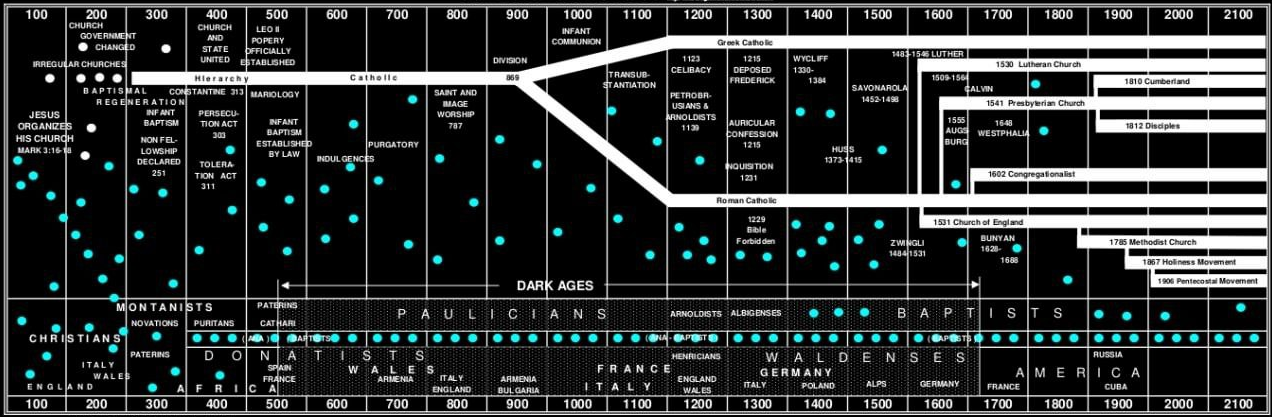

A persistent lie, propagated by Catholic superstition and echoed by many Protestants, is the claim that “true” Christianity was lost for a millennium, only to be “rediscovered” during the Reformation. They point to the 1500s as the birth of a new era. This is a denial of Christ’s promise from Matthew 16:18 that the gates of hell would not prevail against His church.
Baptists are not Protestants. We did not “protest” out of the Catholic Church; we never belonged to it. In fact, we were persecuted by the Protestants. While Rome was building a pagan, state-worshipping ecclesiastical empire, faithful local assemblies—often called by different names—maintained the biblical faith as laid out in Scripture.
Here is the historical testimony of those who knew the truth: that the people we now call Baptists have existed since Jesus walked the earth.
1. The Testimony of Historians and Scholars
Even men who stood outside our faith were forced to admit that the “Anabaptist” movement was no new invention of the 1500s.
Sir Isaac Newton famously observed:
“The Baptists are the only known body of Christians that has not symbolized [compromised] with the Church of Rome.”
John Lawrence Mosheim, a Lutheran historian, admitted the ancient roots of our predecessors:
“The true origin of that sect which acquired the denomination of Anabaptists… is hidden in the depths of antiquity, and is, of consequence, extremely difficult to be ascertained.”
Professor William C. Duncan, holding the chair of Greek and Latin at the University of Louisiana, noted:
“Baptists do not, as most Protestant denominations, date their origin from the Reformation of 1520… for long before Luther lived; yea, long before the Catholic Church itself was known, Baptist and Baptist churches flourished in Europe, Asia and Africa.”
John Clark Ridpath, a Methodist historian, also confessed:
“I should not readily admit that there was a Baptist Church as far back as A. D. 100, though without doubt there were Baptists then, as all Christians were then Baptists.”
— Cole C.D. Definitions of Doctrine, Volume III, “The New Testament Church”
2. The Testimony of the Reformers
The very men who broke away from Rome recognized that they were not “restoring” anything; they were coming late to a battle that had been fought for over a millennium.
Huldrych Zwingli, the Swiss reformer, confessed in 1525:
“The institution of Anabaptism is no novelty but for thirteen hundred years has caused great disturbances in the church [Rome] and has acquired such a strength that the attempt in this age to contend with it appeared futile for a while.”
3. The Admission of Our Persecutors
The Roman Catholic Church has always been the primary adversary of the true church. In their own records, Catholic officials inadvertently confirmed the perpetuity of the believers’ church.
Cardinal Hosius (Stanislaus Hosius), a leader of the Council of Trent, wrote in 1557:
“Were it not for the fact that the Anabaptists have been grievously tormented and cut off with the knife during the past 1,200 years, they would swarm greater than all the Reformers.”
In his work De origine haeresium nostri temporis (On the Origin of the Heresies of Our Time), Hosius explicitly acknowledged the constancy and antiquity of these believers. He observed that if the truth of a faith were judged by the willingness of its followers to die for it, no faith would be more certain than that of the Anabaptists—for they had been systematically punished for over 1,200 years. [Citation: Hosius, De origine haeresium nostri temporis (1557), as translated and cited by early Baptist historians including J.M. Carroll in The Trail of Blood. The Latin phrase “nulli sine neque fuerint iam inde a mille ducentis annis” appears in Hosius’s works and is consistently referenced in Baptist historical literature.]
4. An Unbroken Lineage
William C. King, in his work Crossing the Centuries, summed up our heritage:
“Of the Baptists it may be said that they are not Reformers. These people, comprising bodies of Christian believers… are entirely independent of and distinct from the Greek and Roman churches, and have an unbroken continuity from apostolic days down through the centuries.”
Robert Barclay, a Quaker historian, also admitted:
“…small hidden Christian societies, who have held many of the opinions of the Anabaptists, have existed from the times of the apostles.”
Why This Matters Today
The “Baptist” name is often ridiculed by those who want to hide their own histories in the “depths of antiquity.” If the Catholic Church were the true successor of the apostles, they would not have spent 1,200 years trying to exterminate those who practiced believer’s baptism and local church autonomy.
We do not trace our history to some monk in a monastery. We trace our history to our Lord Jesus Christ.
The Catholic system is a pagan counterfeit. The Protestant movement is a daughter of that counterfeit. But the church that Jesus built—local, autonomous gatherings of baptized believers—has survived every effort of Rome to drown it in blood. History proves that the gates of hell have not prevailed.
See our Baptist History page for more information.